Quick Summary
Industry leaders at the ETRealty Realty and Beyond Ahmedabad panel said Gujarat's next real estate growth cycle needs more than added Grade-A office supply.
Speakers said the market must build a full ecosystem infrastructure, talent access, social amenities and better occupier experience to attract large global employers.
Ahmedabad's commercial market has historically run on captive demand, unlike Bengaluru, Hyderabad and Pune, where multinational and service-sector employers created jobs at scale.
Panelists said Gujarat's industrial base gives it a genuine global capability centre (GCC) opportunity, though the state entered some tech-hub policies later than southern India.
GIFT City was described as "a city, not a project," one that needs housing, retail, transit and social infrastructure alongside office towers to mature.
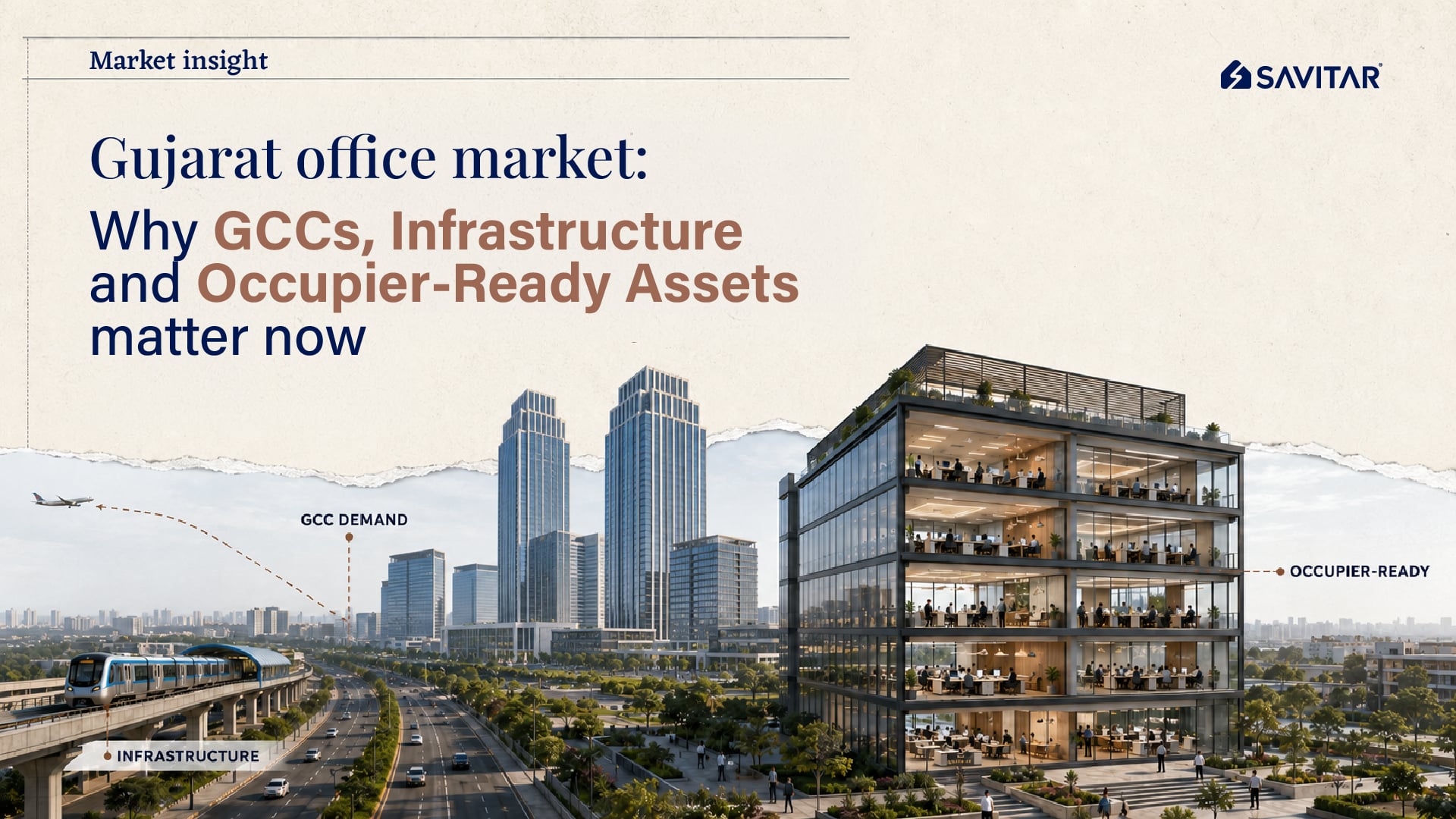
Developers said larger floorplates, better parking and traffic planning, and stronger metro and airport connectivity will decide whether Gujarat can compete for large GCC and corporate occupiers.
Gujarat's office market is entering a new phase, and according to industry experts, supply alone won't carry it. At a recent panel hosted by ETRealty in Ahmedabad, developers, planners and legal experts laid out what the state's commercial real estate sector still needs before it can compete with established hubs like Bengaluru, Hyderabad and Gurugram. Savitar Realty tracks Gujarat's commercial and GIFT City real estate trends so investors and occupiers get the full picture before they make a move.
What happened at the ETRealty panel discussion
The panel discussion, titled "GIFT City, GCCs & Grade-A Offices & Industrial Real Estate: What will power Gujarat's next real estate growth cycle?" was held as part of ETRealty Realty and Beyond Ahmedabad. The session was moderated by Jigar Mota, senior director at Cushman & Wakefield.
The panel included Chitrak Shah, MD of Shivalik Group; Gaurav Hasmukh Gadhecha, partner at Collated Ventures; Sarang Jain, managing director of SJ Sangath Group and president of NAREDCO NextGen Gujarat; Loveleen Garg, chief planner and senior vice president at GIFT City; Nirav Kothary, director at Godwitt Construction; and Delnavaz Patel, counsel at Trilegal.
Why Gujarat's GCC opportunity is real but different from the south
Loveleen Garg pointed out that Ahmedabad's commercial market has historically been driven largely by captive demand, unlike Bengaluru, Hyderabad and Pune, where large multinational and service-sector employers created jobs at scale. She said Gujarat's global capability centre opportunity is significant precisely because of the state's strong industrial base, since large companies increasingly need centralised technology, process and business-function capabilities.
Garg added that successive government initiatives across IT/ITeS, fintech and GCCs are aimed at building this ecosystem, but acknowledged that Gujarat entered some of these policy areas later than established technology hubs in southern India.
GIFT city is a city, not just a project
"It is not a project; it's a city," Garg said, adding that cities mature only as demand, businesses, residents and supporting services come together. She noted that the International Financial Services Centre (IFSC) framework is still relatively young compared with mature global financial centres such as Singapore and Dubai, and that regulatory ecosystems take time to stabilise.
She said multinational occupiers will expect institutional-grade buildings, with large organisations focused on compliance, energy efficiency, building operations and the ability to manage large teams from a single location.
What developers say Gujarat needs to scale
Sarang Jain said developers in GIFT City increasingly function as co-developers of a larger urban ecosystem rather than builders of isolated parcels, since GIFT City authorities work closely with them on infrastructure and project-level issues. He said this gives developers greater confidence, as building access, road connectivity and supporting infrastructure become part of the overall planning process, and that growing participation from Gujarat-based developers is building confidence in the surrounding real estate ecosystem.
Delnavaz Patel said the lessons from GIFT City apply just as much to Gujarat's Tier-II commercial markets. Using Vadodara as an example, she said smaller cities can attract large occupiers only if the surrounding ecosystem, housing, retail, recreation, restaurants and social infrastructure develops alongside employment centres, not after them.
"If GIFT City had the entire ecosystem for a resident available, probably it would have taken a leap quicker," Patel said, arguing that supporting infrastructure should ideally be built before large numbers of occupiers and employees arrive. She said Tier-II Gujarat cities can compete for companies looking for cheaper alternatives to expensive Tier-I markets through lower-cost locations, improving accessibility and more deliberate planning.
Bigger floorplates, better services: The occupier experience gap
Gaurav Hasmukh Gadhecha said larger floorplates will be one of the key requirements if Gujarat wants to attract large GCC and corporate occupiers, since companies need the ability to house large teams on a single floor and simplify operations. He said office assets will also need better planning around parking, traffic movement, ingress, egress and overall employee experience, pointing to established IT-office developments in Hyderabad, where large campuses manage operational details well beyond the minimum parking required by regulation.
He added that developers should increasingly look at commercial real estate from a service perspective, since employees may need food facilities, banking, childcare-related services and reliable last-mile connectivity, especially where offices sit away from established urban centres. He cited GIFT City's shuttle connectivity from the metro station as an example of a last-mile solution that improves the employee experience. "We are now ready to scale," he said, adding that Gujarat can move beyond benchmarking Bengaluru or Gurugram and build its own commercial real estate model.
Infrastructure Gujarat is betting on
Nirav Kothary said Ahmedabad's ongoing infrastructure development could directly support office demand. He said metro connectivity can expand the effective talent pool available to companies, since employees once reluctant to travel to GIFT City could become accessible to employers once reliable transit connects the business district with the rest of Ahmedabad. "Each metro station becomes an office hub," he said, adding that proximity to mass transit can become a major selling point for both occupiers and employees.
Kothary also flagged airport expansion as important, since strong air connectivity is a basic requirement for GCCs and multinational companies, and said Ahmedabad's expanding airport infrastructure could help it compete for global businesses the way air connectivity helped Bengaluru and Hyderabad. He said hospitality needs to grow alongside offices too, noting that Ahmedabad's hotel capacity already comes under pressure during major exhibitions and events. He added that infrastructure built around major sporting events, including the Commonwealth Games, could have a longer-term impact on the city by improving last-mile connectivity, pedestrian infrastructure and urban facilities. "The games will come and go, but the infrastructure will remain with the city forever," he said, adding that the real question is how developers and the city use those assets afterward to sustain economic activity.
Sustainability beyond certification
Chitrak Shah said sustainability should not be reduced to certifications alone, arguing that buildings must improve the experience of the people using them and stay functional over long periods. "Certification is nice, but that's not the end goal," he said. "The end goal is that you touch people's lives when you develop something." He said sustainability should cover occupant wellness, sensitivity towards nature, design quality, ease of maintenance and long-term usability.
Shah also said developers should explore new real estate formats instead of only adding supply in established categories, citing Shivalik Group's work on thematic retail in western Ahmedabad as an example of building differentiated products as the city sees more migration, visitors and business activity.
What this means if you're evaluating office space or a GCC setup in Gujarat
Look past headline Grade-A supply numbers. Check whether the specific micro-market offers metro or transit access, airport connectivity and hotel capacity, since these decide how easily you can staff and run a large team.
Ask about floorplate sizes upfront. If you plan to house a large team on one floor, confirm the building can support it before you commit.
Factor in service infrastructure. Food facilities, banking, childcare and last-mile shuttle connectivity affect employee retention as much as rent does.
Treat GIFT City and Ahmedabad as different but connected options. GIFT City offers the regulatory and financial-services platform; Ahmedabad offers wider infrastructure and Grade-A supply.
Consider Tier-II markets like Vadodara if cost matters more than being in a Tier-I address, but check that housing, retail and social infrastructure are developing alongside the office supply.
Don't judge sustainability claims on certification labels alone. Ask how the building performs on occupant experience, energy use and long-term maintenance.
What this means if you're an investor looking at Gujarat commercial Real Estate
Track infrastructure timelines, not just project launches. Metro extensions, airport expansion and Commonwealth Games-linked infrastructure will shape which micro-markets gain value first.
Watch GCC and multinational occupier announcements closely. Panelists said this demand, not general office construction, will determine which developments perform.
Evaluate developers on ecosystem thinking, not just individual buildings. Projects backed by co-ordinated planning around access, roads and support infrastructure carry lower execution risk.
Look at Tier-II cities such as Vadodara for early-stage entry, but weigh the pace at which surrounding social infrastructure is actually being built.
Verify RERA registration, construction progress and legal status of any project the same way you would for residential real estate. Commercial projects carry the same regulatory scrutiny.
Work with a partner who tracks Gujarat's commercial real estate and GIFT City developments on an ongoing basis rather than relying on a single project brochure.
Read More Blog: BU Permission in Ahmedabad