Residential & Commercial
Joint home loan eligibility and tax benefits explained: Complete guide
25 August 2026
123 Views
Quick Summary
A joint home loan lets two or more applicants combine their income to qualify for a higher loan amount, and it can also double the tax benefits available under the Income Tax Act.
Eligibility depends on combined income, credit score, age, employment type and existing liabilities of all co-applicants, not just the primary borrower.
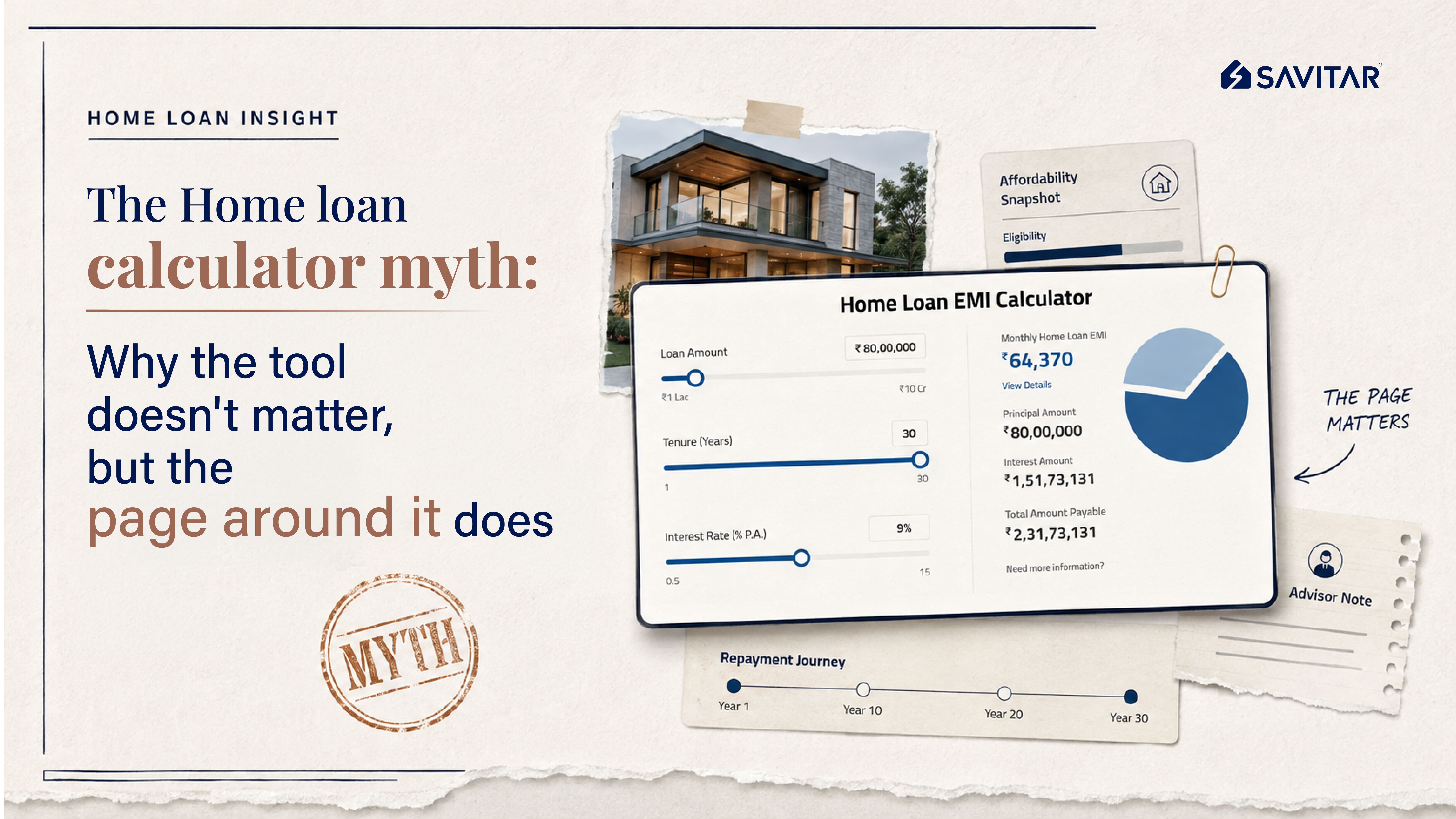
Every major lender, SBI, HDFC, Axis Bank, Bank of Baroda, Bank of Maharashtra, Kotak offers a free online home loan eligibility calculator and EMI calculator that run the same underlying math.
The real difference between lenders isn't the calculator's accuracy, it's how much the surrounding page actually explains. Axis Bank's home loan calculator page runs to roughly 10,292 words, while Bank of Baroda's covers the same tool in about 589 words.
Each co-owner who is also a co-borrower can independently claim up to ₹2 lakh under Section 24(b) and up to ₹1.5 lakh under Section 80C, meaning a couple can potentially claim up to ₹7 lakh in combined annual deductions.
Government employees, defence personnel and first-time buyers under PMAY have access to additional subsidies and concessional schemes that most calculators don't factor in by default.
What is a joint home loan and why it changes your eligibility
A joint home loan is a mortgage taken out by two or more applicants, typically spouses, or a parent and child, or siblings, who share responsibility for repayment. Lenders combine the income of all co-applicants when calculating eligibility, which usually means a meaningfully higher loan amount than any one applicant could get alone.
This matters because home loan eligibility calculators are built around a simple ratio: your total EMI obligations (existing + proposed) shouldn't exceed roughly 40–50% of your net monthly income, depending on the lender's policy. Adding a co-applicant's income directly raises the loan amount this ratio allows, without changing the interest rate or tenure.
Already shortlisting a property? Browse verified, RERA-registered homes and commercial spaces at savitarrealty.com before you lock in your loan amount
Who can be a co-applicant in a joint home loan?
Most lenders, including SBI Home Loan and Bank of Maharashtra, allow the following combinations:
Spouses (husband and wife), the most common and most tax-efficient combination
Parent and child, provided both have independent, verifiable income
Siblings, in some cases, subject to the property being jointly owned
Unmarried couples, at select lenders, though policies vary and property co-ownership is usually required
A key rule that trips up many applicants: to claim tax benefits on a joint home loan, you generally need to be both a co-borrower on the loan and a co-owner of the property. Being named only on the loan application, without being on the property title, can disqualify you from claiming deductions independently.
Joint home loan eligibility: What lenders actually check
Every home loan eligibility calculator asks for similar inputs, but the underlying credit assessment covers more ground than the calculator shows:
Combined gross monthly income of all applicants, including salary, rental income, and other verifiable sources
Credit score of each applicant; most lenders want a CIBIL score of 750+ for the best interest rate, and a low score for any single co-applicant can drag down the overall loan terms
Age and remaining working years, since tenure is often capped at retirement age (typically 60 for salaried, 65–70 for self-employed) for each applicant
Existing EMI obligations, car loans, personal loans, credit card dues, for every applicant, not just the primary one
Employment stability, generally 2–3 years of continuous employment for salaried applicants, or 3–5 years of business continuity for self-employed applicants
Property value and loan-to-value (LTV) ratio, which is capped by RBI norms, up to 90% for loans under ₹30 lakh, 80% for ₹30 lakh–₹75 lakh, and 75% above ₹75 lakh
A home loan emi calculator only tells you what your monthly payment would be at a given loan amount, tenure and rate. A home loan eligibility calculator goes one step further and estimates the maximum loan amount you qualify for based on income and obligations. Applying jointly changes the second number, not the first; the EMI math itself doesn't change once the loan amount is fixed.
How to use a home loan calculator for a joint application
Most home loan online calculators aren't built with a "joint applicant" field, they assume a single income. To estimate joint eligibility accurately:
Add the net monthly income of all co-applicants together.
Subtract the combined existing EMI obligations of all co-applicants.
Enter this combined, net figure into the lender's home loan eligibility calculator as if it were a single income.
Cross-check the result against the youngest applicant's age, since tenure is usually capped by whichever applicant is closest to the retirement age limit.
Run the same numbers through at least two lenders' calculators — SBI, HDFC, Axis Bank, Kotak, Bank of Maharashtra — since each applies slightly different FOIR (Fixed Obligation to Income Ratio) limits, which can shift your eligible amount by 5–10%.
SBI home loan: Eligibility, Calculator and Related Schemes
SBI Home Loan remains one of the most searched options in India, partly because SBI bundles its home loan calculator with a wide set of related tools and schemes on the same journey:
SBI Home Loan Calculator, standard EMI and eligibility calculation based on income, tenure and rate
SBI Pre-Approved Projects, a list of builder projects SBI has already legally and technically vetted, which can speed up loan sanction for buyers purchasing in those projects
PMAY (Pradhan Mantri Awas Yojna): SBI processes the Credit Linked Subsidy Scheme (CLSS) for eligible first-time buyers, which can reduce effective interest cost significantly for EWS, LIG and MIG category applicants
Home loans for defence personnel, concessional processing and, in some cases, relaxed eligibility norms for serving and retired defence personnel
Home loans for government employees, similarly favourable terms, reflecting the lower default risk lenders associate with stable government salaries
Overdraft loan (SBI Maxgain), a home loan variant linked to a savings-style overdraft account, letting borrowers park surplus funds against the loan to reduce interest outgo without foreclosing early
Balance transfer / switch home loan to SBI, borrowers with an existing home loan elsewhere can transfer the outstanding balance to SBI if SBI's current home loan interest rate is lower, potentially reducing the total interest paid over the remaining tenure
For joint applicants specifically, SBI's eligibility calculation combines applicant incomes the same way most lenders do, but its PMAY subsidy and defence/government employee concessions can apply per-applicant, which is worth checking directly with a branch or relationship manager rather than relying on the calculator output alone.
Bank of Maharashtra home loan calculator: What it covers
The Bank of Maharashtra home loan calculator follows the standard format, loan amount, interest rate, tenure and returns an estimated EMI and eligible loan amount.
It's a straightforward, no-frills tool, useful for a quick number but light on the surrounding explanation of joint applications, tax treatment or subsidy eligibility compared to larger private lenders' pages.
If you use Bank of Maharashtra's calculator for a first estimate, it's worth cross-referencing the tax benefit and joint-eligibility detail in this guide rather than expecting the bank's own page to walk you through it.
How calculator pages compare across lenders
This is where the real differentiation between lenders shows up, not in the math, but in the depth of explanation around it. An analysis of home loan calculator pages across major banks found:
Axis Bank's home loan calculator page runs to roughly 10,292 words, covering eligibility scenarios, FAQs, tax benefit explanations, and edge cases like self-employed applicants and co-applicant scenarios in detail.
Bank of Baroda's equivalent page covers the same underlying calculator in about 589 words, functionally identical math, a fraction of the explanation.
HDFC's home loan eligibility calculator page sits closer to the Axis end of the spectrum, with detailed FAQ sections addressing joint applications, income documentation and eligibility boosters.
Kotak's home loan interest rate and EMI calculator pages tend to separate rate information from the calculator itself, requiring buyers to cross-reference two pages for a complete picture.
The takeaway for anyone comparing lenders: don't judge a bank's home loan product by how good its calculator "feels." The formula behind a house loan EMI calculator is standardised, principal, rate, tenure, reducing balance. What actually helps you make a decision is whether the page around the calculator answers the questions you'll have five minutes after seeing your EMI number: Can I add a co-applicant? What if my score is borderline? What tax benefit will I actually get?
Tax benefits on a joint home loan
This is where joint home loans offer a real financial advantage over individual loans, the tax deductions available under the Income Tax Act can effectively be claimed by each co-owner separately, provided they're also co-borrowers.
Section 24(b): Interest on home loan
Each co-owner who is also a co-borrower can claim a deduction of up to ₹2 lakh per financial year on the interest paid, for a self-occupied property. For a joint loan with two co-owners, this means a combined deduction of up to ₹4 lakh, double what a single applicant could claim.
Section 80C: Principal repayment
Each co-owner can separately claim up to ₹1.5 lakh per year on the principal component of the EMI, within the overall Section 80C limit (which also includes PF, ELSS, life insurance premiums and other eligible investments). For two co-owners, this potentially doubles to ₹3 lakh combined, subject to each individual's overall 80C ceiling.
Section 80EE and 80EEA: Additional interest deduction for first-time buyers
First-time homebuyers meeting specific conditions (property value and loan amount caps, and no other owned residential property at the time of loan sanction) may claim an additional deduction, up to ₹50,000 under Section 80EE or up to ₹1.5 lakh under Section 80EEA, depending on the applicable financial year and scheme conditions. Where both co-owners qualify independently, this benefit can also be claimed by each.
Putting the Numbers Together
For a married couple who are joint co-owners and co-borrowers, and both qualify for the maximum deductions:
Section | Per-Person Limit | Combined (2 Applicants) |
24(b), Interest | ₹2,00,000 | ₹4,00,000 |
80C, Principal | ₹1,50,000 | ₹3,00,000 |
Total (excluding 80EE/EEA) | ₹3,50,000 | ₹7,00,000 |
This combined figure is the single biggest reason financial planners recommend structuring a home purchase as a joint loan with joint ownership wherever both applicants have taxable income, the deduction isn't split, it's effectively doubled.
Planning your purchase around this tax math? Talk to a Savitar Realty advisor to structure your co-ownership and loan application correctly from day one, so you don't lose out on deductions due to a documentation gap.
Conditions to Actually Claim These Benefits
A few conditions catch buyers out, so it's worth checking each before assuming you'll get the full combined deduction:
Co-ownership is mandatory. Being a co-borrower on the loan without being named on the property title generally disqualifies you from claiming your own deduction.
Both applicants must have independent taxable income. If only one spouse earns a taxable income, only that spouse can practically use the deduction, even if both are named on the loan.
The EMI contribution should ideally match the ownership share, or at minimum, each applicant should be able to show they're servicing their share of the EMI from their own account, this becomes relevant if the claim is scrutinised.
Possession matters for Section 24(b). The full ₹2 lakh interest deduction (per person) applies once construction is complete and possession is taken; pre-construction interest is claimed separately, in five equal instalments starting the year possession is received.
The property must be self-occupied or deemed let-out for the deduction structure described above to apply; rules differ for a fully let-out property, where interest deduction is not capped at ₹2 lakh but rental income is taxable.
PMAY subsidy and joint home loans
Under the Pradhan Mantri Awas Yojna Credit Linked Subsidy Scheme, eligible first-time buyers in the EWS, LIG and MIG income categories can receive an interest subsidy, credited upfront to reduce the effective loan principal.
For joint applications, the subsidy is generally calculated on the combined household income and is available once per family unit, meaning a couple applying jointly should apply for PMAY as a single household rather than expecting the subsidy twice. Lenders including SBI Home Loan process PMAY subsidy claims directly as part of the loan disbursement process.
Balance transfer: Switching your joint home loan to a better rate
If your existing joint home loan carries a higher interest rate than what's currently available, a balance transfer lets you move the outstanding loan to a new lender, for example, choosing to switch home loan to SBI if SBI's current home loan interest rate is meaningfully lower than your existing lender's. Before switching, it's worth checking:
The processing fee and any prepayment charges on your existing loan (RBI rules exempt floating-rate loans from prepayment penalties for individual borrowers, but it's worth confirming)
Whether the new lender requires all original co-applicants to be re-verified and re-added as co-borrowers on the new loan
Whether your tax deduction eligibility resets or continues seamlessly, generally, it continues, since the underlying loan purpose (property purchase/construction) doesn't change
The new lender's own home loan eligibility calculator result, to confirm the transferred loan amount and tenure still fit comfortably within your combined income
What this means if you're applying for a joint home loan
Combine both applicants' net income (after deducting existing EMIs) before running any home loan eligibility calculator, to get a realistic estimate rather than a single-income figure.
Check each co-applicant's credit score individually; a low score for either applicant can affect the interest rate offered on the whole loan.
Make sure both co-borrowers are also listed as co-owners on the property title if you want to claim tax benefits independently.
If either applicant is a first-time buyer, check eligibility for Section 80EE/80EEA and PMAY subsidy before finalising the loan amount, since these can meaningfully change the effective cost.
If one applicant is a government employee or defence personnel, ask the lender directly about applicable concessional schemes, these usually aren't reflected in the standard online calculator.
Keep proof that each co-applicant is servicing their proportionate share of the EMI from their own bank account, in case your tax deduction claim needs to be substantiated later.
What this means if you're comparing home loan calculators across banks
Don't choose a lender based on how detailed or polished their calculator page looks the EMI and eligibility math is standardised across SBI, HDFC, Axis Bank, Kotak, Bank of Maharashtra and Bank of Baroda.
Use calculator output as a starting estimate only; the final sanctioned amount depends on document verification, credit bureau checks and the lender's internal policy, which can differ from the online estimate.
Cross-check your eligibility on at least two or three lenders' calculators, since FOIR limits and interest rate slabs vary and can shift your eligible loan amount by a meaningful margin.
Read the FAQ section on longer, more detailed calculator pages (like Axis Bank's) even if you plan to apply elsewhere, the explanations of joint applications, tax treatment and edge cases tend to be more thorough there and apply generally, not just to that one lender.
Compare actual home loan interest rates and processing fees separately from the calculator, since the calculator only reflects whatever rate you manually enter, it doesn't tell you which lender's real rate is lowest for your profile.
Ready to Turn Your Eligibility Into an Actual Home?
Knowing your loan eligibility and tax benefits is only half the equation; the other half is finding a property that's worth financing. Savitar Realty helps buyers shortlist verified, RERA-registered residential and commercial properties, cross-check them against your loan eligibility, and connect with lenders offering the best current rates for your profile.
Everything you need before you decide.
Still have questions? Our team is here to help.
- Does a joint home loan actually double my eligibility?
Not exactly double, but combining incomes typically raises your eligible loan amount significantly, since lenders base eligibility on total combined income minus combined existing obligations, run through the same FOIR ratio used for a single applicant.
- Can both co-applicants claim tax benefits on the same home loan?
- Is a home loan eligibility calculator the same as an EMI calculator?
- Why do some banks' home loan calculator pages have far more content than others?
- Can I claim PMAY subsidy and Section 24(b)/80C deductions together?
Everything you need before you decide.
Still have questions? Our team is here to help.
- Does a joint home loan actually double my eligibility?
Not exactly double, but combining incomes typically raises your eligible loan amount significantly, since lenders base eligibility on total combined income minus combined existing obligations, run through the same FOIR ratio used for a single applicant.
- Can both co-applicants claim tax benefits on the same home loan?
- Is a home loan eligibility calculator the same as an EMI calculator?
- Why do some banks' home loan calculator pages have far more content than others?
- Can I claim PMAY subsidy and Section 24(b)/80C deductions together?