Residential & Commercial
Ahmedabad CWG Prep: Koteshwar-Hansol River Bridge to Link Airport and Stadium
26 August 2026
115 Views
Quick Summary
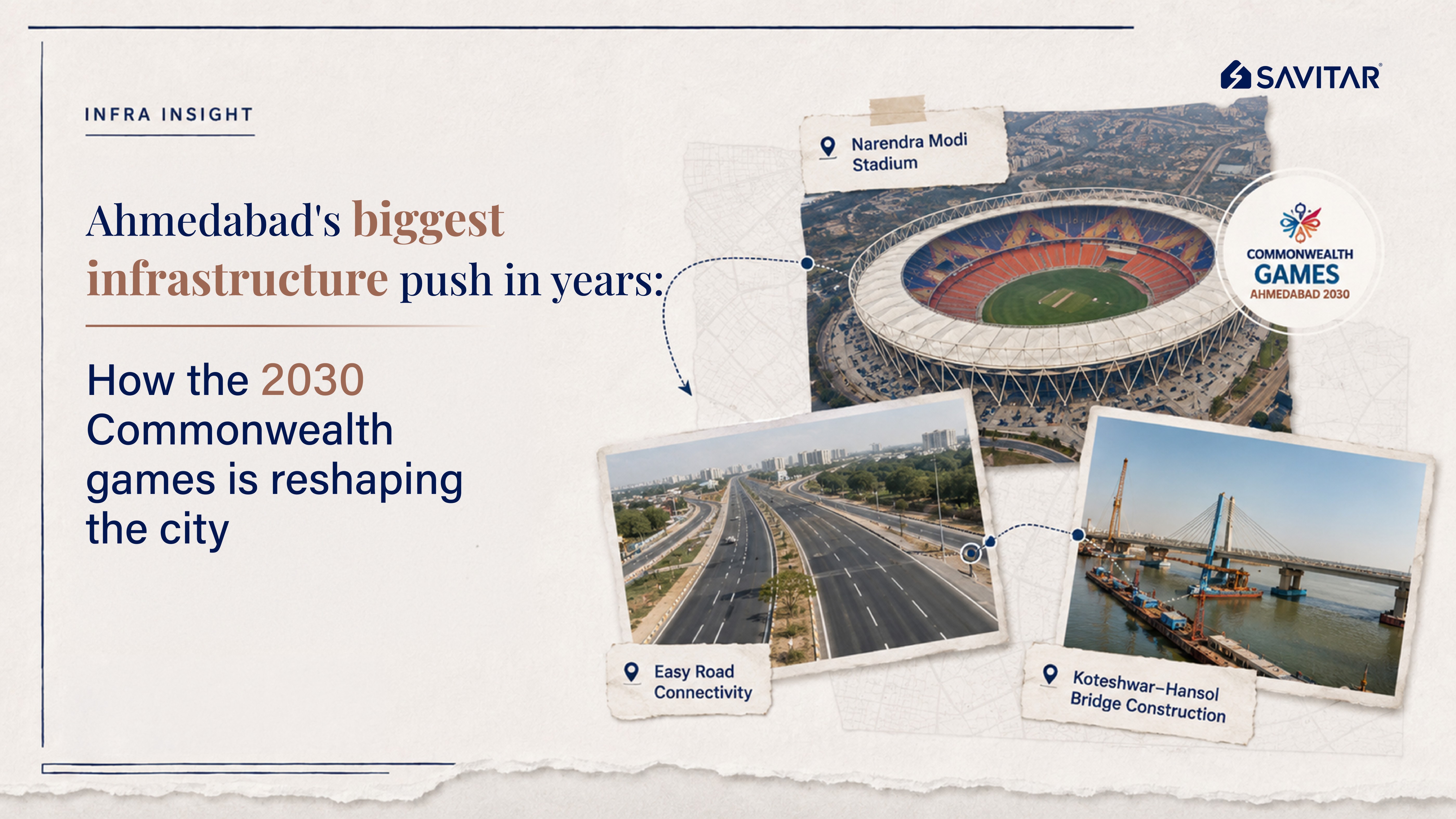
AMC is building the Koteshwar-Hansol river bridge to connect Ahmedabad airport directly to Narendra Modi Stadium, ahead of the 2030 Commonwealth Games.
Two 30-metre-wide approach roads to the Sabarmati river are already approved under the Town Planning schemes of Koteshwar and Hansol.
A foot overbridge behind the stadium and a barrage-cum-bridge near Sabarmati Aatma Crematorium are also under construction.
AMC has allocated Rs 1,000 crore for two elevated corridors, and the Sabarmati Toll Naka to Narendra Modi Stadium route is being widened to 61 metres.
Flyovers and railway overbridges are planned or underway at Visat Junction, Sanand Junction, and four railway crossings across the city.
Ahmedabad is also in the running to host the 2036 Olympics, and AMC wants this infrastructure network to outlast the Commonwealth Games.
The Olympic Cell of AUDA is separately developing the Sardar Patel Sports Enclave, the land zone surrounding the stadium itself.
What AMC is building around Narendra Modi Stadium
AMC is constructing the Koteshwar-Hansol river bridge to give Ahmedabad airport a direct link to Narendra Modi Stadium. This is the single biggest piece of the plan, and it solves a problem that has existed for years: getting from the airport to the stadium currently means routing through busier parts of the city rather than a direct crossing over the Sabarmati.
The civic body has already approved two 30-metre-wide roads leading to the river, under the Town Planning schemes of Koteshwar and Hansol. Wide approach roads matter here because they set the capacity for how much traffic the new bridge can actually carry once it opens. A narrow approach road would bottleneck the benefit of a wide bridge, so AMC is building both pieces together rather than adding the roads later.
A foot overbridge behind the stadium is also planned, aimed at pedestrian movement for match days and events, separate from vehicle traffic. The river bridge itself will connect to a new tunnel running beneath the firing range near Taj Hotel, which lets the route bypass a restricted zone without a lengthy detour. Separately, construction of a barrage-cum-bridge is progressing near the Sabarmati Aatma Crematorium, adding another river crossing point in the same stretch of the city.
An AMC source described the approach directly: ahead of the Commonwealth Games, planning is focused on widening approach roads and opening new road networks leading to the stadium. That framing matters. This isn't a single flagship bridge project standing alone. It's one piece of a coordinated network designed to move traffic from multiple directions toward the same venue zone.
If you own property or plan to buy along these corridors, this article covers what is confirmed so far. Savitar Realty tracks infrastructure and connectivity projects across Ahmedabad so buyers get the full picture before they invest.
Why this push is happening now
Ahmedabad is set to host the 2030 Commonwealth Games, and the Sardar Vallabhbhai Patel Sports Enclave, developing around Narendra Modi Stadium, is the primary venue zone. Hosting an event of this scale means AMC needs the enclave well connected from every direction well before the opening ceremony, not scrambling in the final months.
There is a second, longer-term reason too. Ahmedabad is also vying to host the 2036 Olympics. That single fact changes how this infrastructure gets planned. A city building only for a two-week Commonwealth Games might get away with temporary fixes: pop-up shuttle routes, traffic diversions, short-term road patches. A city with an Olympic bid on the table has to build permanent capacity, because the same venues and the same road network will need to work again, at a larger scale, roughly six years later.
That explains why the Olympic Cell of the Ahmedabad Urban Development Authority (AUDA) is separately leading development of the Sardar Patel Sports Enclave across the land parcels surrounding the stadium. Two agencies working the same zone from different angles, AMC on roads and bridges, AUDA on the enclave itself, points to a coordinated, multi-year master plan rather than a short-term event fix. Other Commonwealth Games and Olympic host cities have followed a similar pattern: build once, build permanently, and let the event set the deadline rather than the scope.
What else AMC has approved
Along with the river bridge, AMC has moved on several other fronts, each targeting a different part of the city's approach to the stadium and the airport:
Rs 1,000 crore allocated for two elevated corridors: a 3km stretch from Nehrunagar Circle, via Shivranjani Crossroads and Ramdevnagar Junction, to Iscon Bridge; and a 3.5km stretch from Bopal Vakil Saheb Bridge to Ghuma village. These corridors sit in fast-growing residential pockets, and elevated roads at this scale typically take years from allocation to completion, so this is a project to track over a longer horizon.
A split flyover approved at Visat Junction along the BRTS corridor connecting Sabarmati and Chandkheda, with the design finalised in 2024 and the project now fast-tracked. Visat Junction is a known congestion point, and a split flyover design usually means traffic gets separated by direction rather than funnelled through a single structure.
A feasibility report being drafted for a railway overbridge linking Ranip Bakramandi to Sabarmati Jawahar Chowk, considered a crucial route from Ranip to the stadium. This one is still at the study stage, so it's earlier in the pipeline than the river bridge or the Visat flyover.
A double-level flyover-cum-railway overbridge proposed at Sanand Junction on SG Highway, a corridor that connects Ahmedabad to its industrial belt toward Sanand.
Railway overbridges planned at four more crossings: Geratpur railway station, Maninagar, Punit Nagar, and Vatva-Vinzol. Railway crossings are frequent chokepoints in Ahmedabad's traffic flow, so clearing several of them at once is a meaningful, if less visible, part of the overall plan.
Background: A city-wide plan, not a stadium road
This work traces back to a long-standing complaint from residents in Ahmedabad's western localities: traffic congestion that has only grown as the city has expanded outward. To fix that ahead of the Games, AMC is widening the route from Sabarmati Toll Naka to Narendra Modi Stadium to 61 metres, close to a ten-lane equivalent width once fully built out.
Demolition work along this corridor is already underway, and the stretch is expected to open after the monsoon. Anyone living or working near this route should expect visible construction activity in the near term before the benefit shows up as faster commute times.
Additional river bridges are planned to give commuters from Chandkheda, Sabarmati, Ranip, Vadaj and Naranpura a smoother route to the airport. These are all established residential localities on Ahmedabad's western side, and better airport access from each of them is a meaningful upgrade rather than a marginal one, since airport connectivity is one of the metrics that shapes how a locality is perceived over time.
Put together with the flyovers, railway overbridges and elevated corridors described above, this adds up to a citywide connectivity upgrade, not a single access road built for a fortnight of competition. It also sits alongside Ahmedabad's other ongoing infrastructure pushes, including metro expansion and airport capacity growth, both of which are widely seen as long-term drivers of the city's commercial and residential real estate market, independent of the Commonwealth Games timeline.
What this means if you live or own property along these corridors
Track the Visat Junction flyover. It is fast-tracked, so construction activity and possible road disruption near Sabarmati and Chandkheda could pick up soon.
Watch the Sabarmati Toll Naka to stadium corridor. It is slated to open after the monsoon, and demolition work is already underway nearby, so expect some short-term disruption before the corridor is functional.
Keep an eye on the railway overbridge feasibility studies at Geratpur, Maninagar, Punit Nagar and Vatva-Vinzol, since these can affect commute routes once construction actually starts, even though they're still at the planning stage.
Note that river bridges planned for Chandkheda, Sabarmati, Ranip, Vadaj and Naranpura are meant to improve airport access, which is a factor worth tracking if you rent out or plan to sell property in these localities.
If your property sits along the Nehrunagar Circle to Iscon Bridge or Bopal Vakil Saheb Bridge to Ghuma village stretch, factor in a multi-year construction timeline, since elevated corridors of this length are rarely fast projects, even when funding is already approved.
Keep records of any government notices related to demolition, road widening or land acquisition near your property, particularly if you are close to the Sabarmati Toll Naka corridor or the Koteshwar-Hansol bridge alignment.
If you want to track how these projects are shaping property value in your locality, check RERA-registered project updates for Ahmedabad on Savitar Realty.
What this means if you are considering buying near these areas
Check whether a property sits along one of the corridors getting widened or a new flyover, since these routes are likely to see faster commute times once complete.
Confirm current construction timelines directly with AMC or local news updates rather than relying on a broker's claim of "upcoming connectivity," since informal timelines often run well ahead of actual government schedules.
Weigh short-term disruption against long-term gain. Demolition and construction near Sabarmati Toll Naka, for instance, may cause temporary inconvenience before the corridor opens after the monsoon.
Look at how close a project is to the Sardar Patel Sports Enclave. Areas closer to the stadium and the planned river bridge are likely to see the earliest connectivity improvements, given AMC's stated priority on this zone.
Remember that infrastructure built for the Commonwealth Games is designed to stay permanently, so these upgrades are not temporary event-only fixes, unlike some Games-related infrastructure in other host cities that was built with a shorter lifespan in mind.
Compare a shortlisted property's distance to both the existing metro network and these new road projects. Locations that benefit from both tend to hold connectivity value over a longer period than those relying on road upgrades alone.
If you're buying for rental yield rather than personal use, factor in that improved airport and stadium access in western Ahmedabad could support demand from event-related short stays and business travel around 2030, on top of regular tenant demand.
Ready to shortlist properties near these growth corridors? Browse RERA-checked residential and commercial listings near GIFT City and western Ahmedabad on Savitar Realty.
Everything you need before you decide.
Still have questions? Our team is here to help.
- What is the Koteshwar-Hansol river bridge?
It is a river bridge AMC is building to connect Ahmedabad airport directly to Narendra Modi Stadium, ahead of the 2030 Commonwealth Games. Two 30-metre-wide approach roads under the Koteshwar and Hansol Town Planning schemes have already been approved.
- Why is Ahmedabad building so much infrastructure right now?
- Which areas of Ahmedabad will see the most change?
- When will the Sabarmati Toll Naka to stadium corridor open?
- Is this infrastructure only for the Commonwealth Games?
Everything you need before you decide.
Still have questions? Our team is here to help.
- What is the Koteshwar-Hansol river bridge?
It is a river bridge AMC is building to connect Ahmedabad airport directly to Narendra Modi Stadium, ahead of the 2030 Commonwealth Games. Two 30-metre-wide approach roads under the Koteshwar and Hansol Town Planning schemes have already been approved.
- Why is Ahmedabad building so much infrastructure right now?
- Which areas of Ahmedabad will see the most change?
- When will the Sabarmati Toll Naka to stadium corridor open?
- Is this infrastructure only for the Commonwealth Games?