Residential/Group Housing
Gujarat Rent Bill 2026: What Changes for Landlords and Tenants
12 September 2026
135 Views
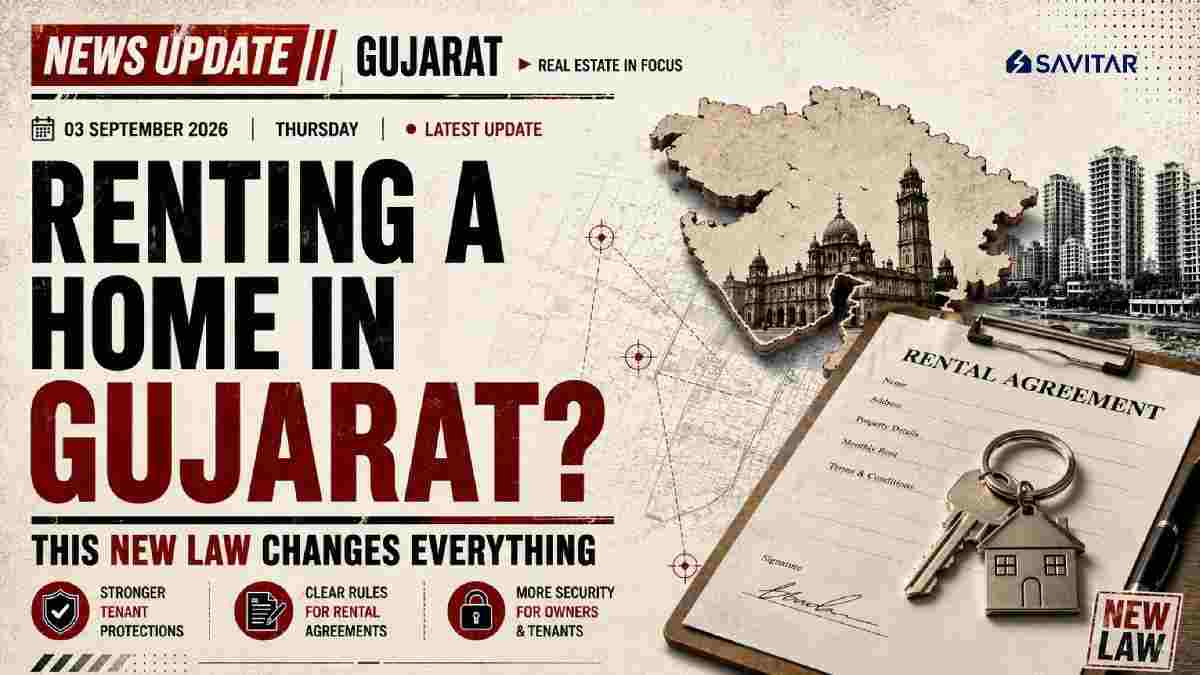
The Gujarat Assembly has passed the Gujarat Rent Bill, 2026, and it changes the rules for anyone who rents out a home or shop in the state, or lives in one on rent. The Bill was passed on 11 September 2026, without a single vote against it.
It replaces a law from 1947. If you own rental property in Ahmedabad, Gandhinagar, or anywhere else in Gujarat, or you pay rent every month, here is what you need to know, in plain words.
What Is the Gujarat Rent Bill 2026?
The Bill takes the place of the Bombay Rents, Hotel and Lodging House Rates Control Act, 1947. That law is nearly 80 years old and did not fit today's rental market.
Urban Development Minister Kanubhai Desai introduced the new Bill in the Assembly. He said the old law had to be extended again and again, and it caused legal trouble for both landlords and tenants. The new law is meant to fix that.
The Bill covers both residential and commercial rented properties.
Written Rental Agreement Is Now Compulsory
Until now, many people in Gujarat rented out or rented in a property on a verbal understanding, or a simple paper that was never registered anywhere. That will no longer work.
Under the new Bill:
No residential or commercial property can be rented out without a written agreement.
Details of the agreement must be jointly submitted to the Rent Authority by the landlord and tenant.
A new digital platform, in Gujarati, will be built within three months of the law coming into force.
Every rental agreement uploaded on this platform gets a unique identification number. This ID becomes proof of the agreement for both sides.
Read more: TDS on Purchase of Property: Complete Guide to Section 194-IA
Security Deposit Capped at 3 Months' Rent
This is the change most tenants have been waiting for.
The Bill caps the security deposit at three months' rent. Landlords who were asking for six months, a year, or more will now have to stick to this limit.
There is a rule for landlords too: once a tenant moves out and all dues are cleared, the deposit must be returned within one month.
Three-Tier System to Settle Rent Disputes
Rent disputes in Gujarat used to drag on in civil courts for years. The new Bill sets up a faster, three-step system:
Rent Authority – handles registration of agreements and first-level issues.
Rent Court – hears disputes such as non-payment of rent or eviction cases.
Rent Tribunal – the next level for appeals.
The goal is a time-bound process, so cases don't stay pending for years like before.
Landlords Cannot Cut Off Water, Power, or Gas
The Bill clearly states that landlords cannot stop essential services — electricity, water, and gas — to pressure a tenant, even during a dispute. If a landlord does this, the Rent Authority can order the services restored right away.
When Can a Landlord Evict a Tenant? (Section 21)
The Bill lists specific grounds for eviction under Section 21. A landlord can approach the Rent Court for eviction if the tenant:
Repeatedly fails to pay rent
Damages the property
Sublets the property without permission
This gives both sides clarity — landlords know when they have a legal right to evict, and tenants know they won't lose their home without a valid reason.
Relief When a Property Becomes Uninhabitable
If a rented property becomes unlivable because of a flood, earthquake, or cyclone, the tenant is not left to deal with it alone. The Bill allows for:
A waiver of rent for the period the property cannot be used, or
An extension of the lease once the property is fit to live in again
Property Managers Get Legal Recognition (Section 18)
Many landlords, especially those who don't live in the same city as their property, hire someone to manage it. Section 18 now gives this role legal standing. A landlord can officially appoint a property manager to handle rent collection, maintenance, and related matters within the framework of this law.
Read more: Foxconn Investment in Gujarat: Scouting Land Near Sanand
Which Properties Are Exempt? (Section 3)
Not every property in Gujarat falls under this new law. Section 3 keeps these out of its scope:
Government premises
Service quarters given by companies to employees
Properties owned by religious or charitable trusts
Properties under the Waqf Board or public trusts
That said, if both the owner and the occupant agree, these properties can still choose to come under the Act.
What This Means If You're a Landlord in Gujarat
Keep every rental deal in writing from now on — verbal agreements won't hold up.
Don't collect more than three months' rent as deposit.
Register the agreement on the new digital platform once it's live.
Know your eviction rights under Section 21, and use the Rent Court instead of taking matters into your own hands.
What This Means If You're a Tenant in Gujarat
You can't be asked for a deposit above three months' rent.
Your landlord cannot cut your electricity, water, or gas over a dispute.
You get a documented, numbered agreement that protects you legally.
If disaster damages your rented home, you have a legal right to a rent waiver or lease extension
Related Reading on Savitar Realty
Everything you need before you decide.
Still have questions? Our team is here to help.
- When was the Gujarat Rent Bill 2026 passed?
The Gujarat Assembly passed it on 11 September 2026. It was passed unanimously, with no opposition.
- Which law does the Gujarat Rent Bill 2026 replace?
- What is the maximum security deposit a landlord can ask for now?
- Is a written rental agreement compulsory under the new law?
- How long does a landlord have to return the security deposit?
Everything you need before you decide.
Still have questions? Our team is here to help.
- When was the Gujarat Rent Bill 2026 passed?
The Gujarat Assembly passed it on 11 September 2026. It was passed unanimously, with no opposition.
- Which law does the Gujarat Rent Bill 2026 replace?
- What is the maximum security deposit a landlord can ask for now?
- Is a written rental agreement compulsory under the new law?
- How long does a landlord have to return the security deposit?