Residential/Group Housing
AUDA-GUDA Merger: What the Ahmedabad–Gandhinagar Mega Urban Authority Means for Property Buyers (2026)
29 June 2026
628 Views
Quick Summary
The Gujarat government is preparing to merge AUDA (Ahmedabad Urban Development Authority) and GUDA (Gandhinagar Urban Development Authority) into a single joint urban authority for the Ahmedabad–Gandhinagar region.
The combined planning area is set to grow from roughly 2,600 sq km today to 5,000–6,000 sq km, bringing two municipal corporations, two authorities and five municipalities under one umbrella.
The exercise is tied to a new Development Plan-2041 (DP-2041) and the region's push for the 2030 Commonwealth Games and India's 2036 Olympics bid.
The new body will be modelled on Mumbai's MMRDA, with uniform town planning schemes, FSI and zoning rules, plus integrated BRTS, Metro and City Bus services.
For homebuyers and investors, the merger points to better infrastructure, clearer rules and likely long-term appreciation in fast-growing pockets like the GIFT City–Sargasan–Kudasan belt, Sanand, Kalol, Dahegam and Bavla.
If you are buying a flat or plot anywhere between Ahmedabad and Gandhinagar, the proposed AUDA-GUDA merger is one of the most important policy shifts to understand in 2026. It will quietly reshape how land is planned, what you can build, and where property values move next. This guide explains the merger in plain language — what it is, why it is happening now, which areas stand to gain, and what it practically means for your buying decision.
What Is the AUDA-GUDA Merger?
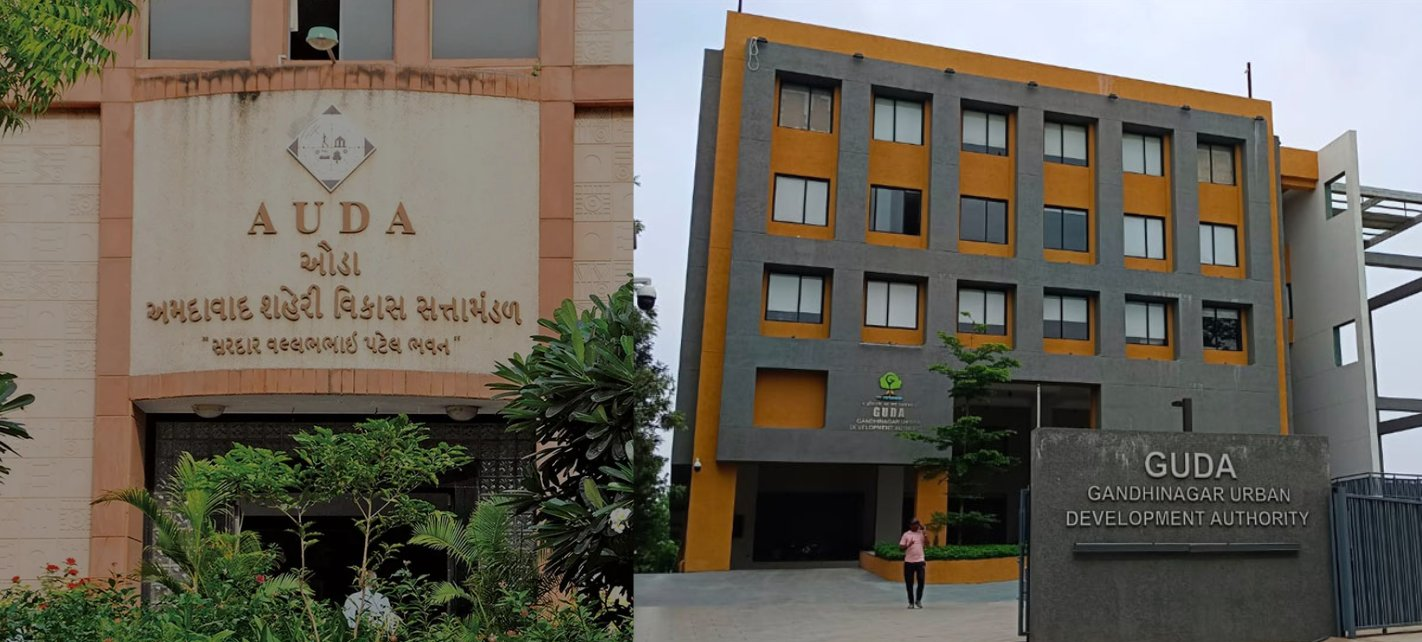
The AUDA-GUDA merger is a Gujarat government plan to combine the Ahmedabad Urban Development Authority and the Gandhinagar Urban Development Authority into a single joint urban authority that will plan and govern the entire Ahmedabad–Gandhinagar region as one unit.
Today, the two cities are planned separately. AUDA, established on 1 February 1978, governs Ahmedabad and its surrounding villages, while GUDA, created on 12 March 1996, handles Gandhinagar capital city and the villages around it. Under the merger, both will work under one administrative structure, with a new Development Plan-2041 (DP-2041) already being prepared to guide growth across the unified region.
In simple terms: instead of two separate rulebooks for two neighbouring cities, the Ahmedabad–Gandhinagar conurbation will move towards one rulebook, one master plan, and one development authority.
Why Is Gujarat Merging AUDA and GUDA Now?
The timing is driven by the region's biggest-ever infrastructure ambitions. Gujarat wants Ahmedabad–Gandhinagar to function as a single, world-class metropolitan region capable of hosting global events.
Three forces are pushing the merger forward:
The 2036 Olympics bid: India is bidding to host the 2036 Summer Olympics, with the Ahmedabad–Gandhinagar region positioned as the proposed host. The bid is not yet awarded, but planning is already moving ahead.
The 2030 Commonwealth Games: Ahmedabad is confirmed to host the centenary edition of the Commonwealth Games, which demands a city-wide infrastructure upgrade.
A unified Development Plan-2041: A single long-term master plan helps the government deliver roads, transit, utilities and venues without two authorities working at cross purposes.
Policymakers want the modern facilities and economic momentum that world-class events require — and a fragmented, two-authority system makes that harder to deliver.
How Big Will the New Ahmedabad–Gandhinagar Urban Authority Be?
The single biggest change is scale. The merged authority is planned to roughly double the area under unified urban planning.
Detail | Current Position | After the Merger (Planned) |
Planning area | ~2,600 sq km (combined authority area cited in the plan) | 5,000–6,000 sq km |
Governing bodies | Two separate authorities (AUDA, GUDA) | One joint urban authority |
Civic bodies covered | Planned separately | 2 municipal corporations, 2 authorities, 5 municipalities |
Master plan | Separate plans (RDP-2021 / GUDA DP) | One Development Plan-2041 (DP-2041) |
For reference, AUDA on its own currently covers roughly 1,866 sq km across Ahmedabad and surrounding villages, while GUDA covers about 388 sq km around the capital. These figures are approximate and shift as boundaries change; officials cite the current combined authority area at around 2,600 sq km. Pulling the two authorities together — and adding new peripheral areas — is what takes the unified region towards the 5,000–6,000 sq km mark. According to officials, in the near future close to 25% of Gujarat's total population is likely to live within this single conurbation.
What Will Actually Change Under the Merger?
The merger is not just an administrative reshuffle. It changes the day-to-day rules that decide what gets built and how the region runs.
What Changes | What It Means for You |
Uniform town planning, FSI & zoning | The same building, floor-space and land-use rules across both cities — fewer grey zones and surprises |
MMRDA-style model | Like Mumbai's MMRDA, one body will handle development, pollution control and waste management for the whole region |
Integrated public transport | BRTS, Metro and City Bus brought under one umbrella for smoother, connected commuting |
New growth areas added | Industrial and peripheral zones brought into planned development with uniform infrastructure |
This is the part that matters most to buyers. Uniform FSI and zoning mean a builder project on the Gandhinagar side will follow the same logic as one on the Ahmedabad side, making approvals and land use more predictable. Predictability is exactly what lowers risk for end-users and investors.
Which Areas Will Benefit Most From the AUDA-GUDA Merger?
The plan specifically pulls several industrial and peripheral pockets into the unified development framework. These are the areas to watch.
Area | Why It Matters |
Sanand | Established auto and manufacturing hub; uniform infrastructure boosts residential demand nearby |
Kalol & Chhatral | Industrial corridors gaining planned civic infrastructure |
Dahegam & Changodar | Peripheral growth zones brought into the master plan |
Bavla | Industrial belt on the south-west corridor |
Mehmedabad (Kheda) | OG areas of Kheda district included for uniform infrastructure |
GIFT City–Sargasan–Kudasan belt | The finance-and-IT corridor that already drives the strongest end-user demand |
The corridor connecting Ahmedabad to Gandhinagar via the SG Highway, GIFT City and Infocity is the clearest beneficiary. Localities like Sargasan and Kudasan already enjoy strong demand from professionals — a unified authority and better-connected transit only strengthen that case. If you are studying this belt,
Read More: Sargasan real estate trends 2026 guide breaks down current rates, ROI and connectivity in depth.
How Will the Merger Affect Property Prices in Ahmedabad and Gandhinagar?
Historically, large infrastructure and event-led upgrades support property values over the medium-to-long term rather than overnight. Better roads, integrated metro and predictable zoning make previously overlooked locations more attractive to buyers — and that gradually feeds into prices.
A few honest expectations:
Long-term appreciation, not a sudden spike. Merger benefits play out over years as infrastructure is delivered, not in a single quarter.
Peripheral and corridor areas have the most headroom. Pockets like Sanand, Kalol, Dahegam and the GIFT City belt have more room to grow than already-premium central areas.
Construction costs are a separate, near-term pressure. Builders have also flagged material-driven price increases.read our breakdown of the Ahmedabad property price rise from July 2026 before you time a purchase.
In short, the AUDA-GUDA merger strengthens the fundamentals of the Ahmedabad–Gandhinagar market. It is a reason for confidence in the region's direction, not a signal to overpay speculation.
What Should Homebuyers and Investors Do Now?
A big policy shift is a good moment to buy smart, not to rush. Use the merger as a reason to focus on well-located, well-planned property — then do your due diligence.
Buy on fundamentals. Prioritise connectivity, builder track record and RERA registration over hype about future events.
Target the corridor. The Ahmedabad–Gandhinagar belt — especially GIFT City-adjacent and SG Highway pockets — combines genuine demand with infrastructure upside.
Verify the land record. Always confirm ownership and zoning before paying an advance.
Read More: online property card in Gujarat shows how to check ownership through AnyROR and e-Milkat.
Treat timelines as bonuses. Event deadlines and master plans can shift. Buy something that makes sense even if every project arrives a little late.
AUDA vs GUDA vs the New Unified Authority
Feature | AUDA | GUDA | New Joint Authority (Planned) |
Established | 1 February 1978 | 12 March 1996 | Under preparation (DP-2041) |
Covers | Ahmedabad + surrounding villages | Gandhinagar capital + villages | Entire Ahmedabad–Gandhinagar region |
Approx. area | ~1,866 sq km | ~388 sq km | 5,000–6,000 sq km |
Master plan | RDP-2021 | GUDA Development Plan | Single DP-2041 |
Model | City development authority | City development authority | MMRDA-style metropolitan body |
You can read more about the existing authority and its schemes on the official Ahmedabad Urban Development Authority (AUDA) website, and the original announcement was reported by DeshGujarat.
Disclaimer: This article is based on government announcements and industry reports available at the time of writing and is shared for general information only. Plans, areas, timelines, and the 2036 Olympics bid are subject to change. Always verify RERA registration, land records and current pricing directly with the developer and official Gujarat government portals before making any property decision. Savitar Realty is not a legal or financial advisor.
Everything you need before you decide.
Still have questions? Our team is here to help.
- What is the AUDA-GUDA merger?
It is a Gujarat government plan to combine the Ahmedabad Urban Development Authority (AUDA) and the Gandhinagar Urban Development Authority (GUDA) into a single joint urban authority that plans the entire Ahmedabad–Gandhinagar region under one Development Plan-2041.
- Why is Gujarat merging AUDA and GUDA?
- How big will the new Ahmedabad–Gandhinagar authority be?
- Will the AUDA-GUDA merger increase property prices?
- Which areas will benefit most from the merger?
Everything you need before you decide.
Still have questions? Our team is here to help.
- What is the AUDA-GUDA merger?
It is a Gujarat government plan to combine the Ahmedabad Urban Development Authority (AUDA) and the Gandhinagar Urban Development Authority (GUDA) into a single joint urban authority that plans the entire Ahmedabad–Gandhinagar region under one Development Plan-2041.
- Why is Gujarat merging AUDA and GUDA?
- How big will the new Ahmedabad–Gandhinagar authority be?
- Will the AUDA-GUDA merger increase property prices?
- Which areas will benefit most from the merger?